
After more than three decades of working across public-sector and enterprise procurements, one pattern remains consistent:
the RFP rarely starts the real competition.
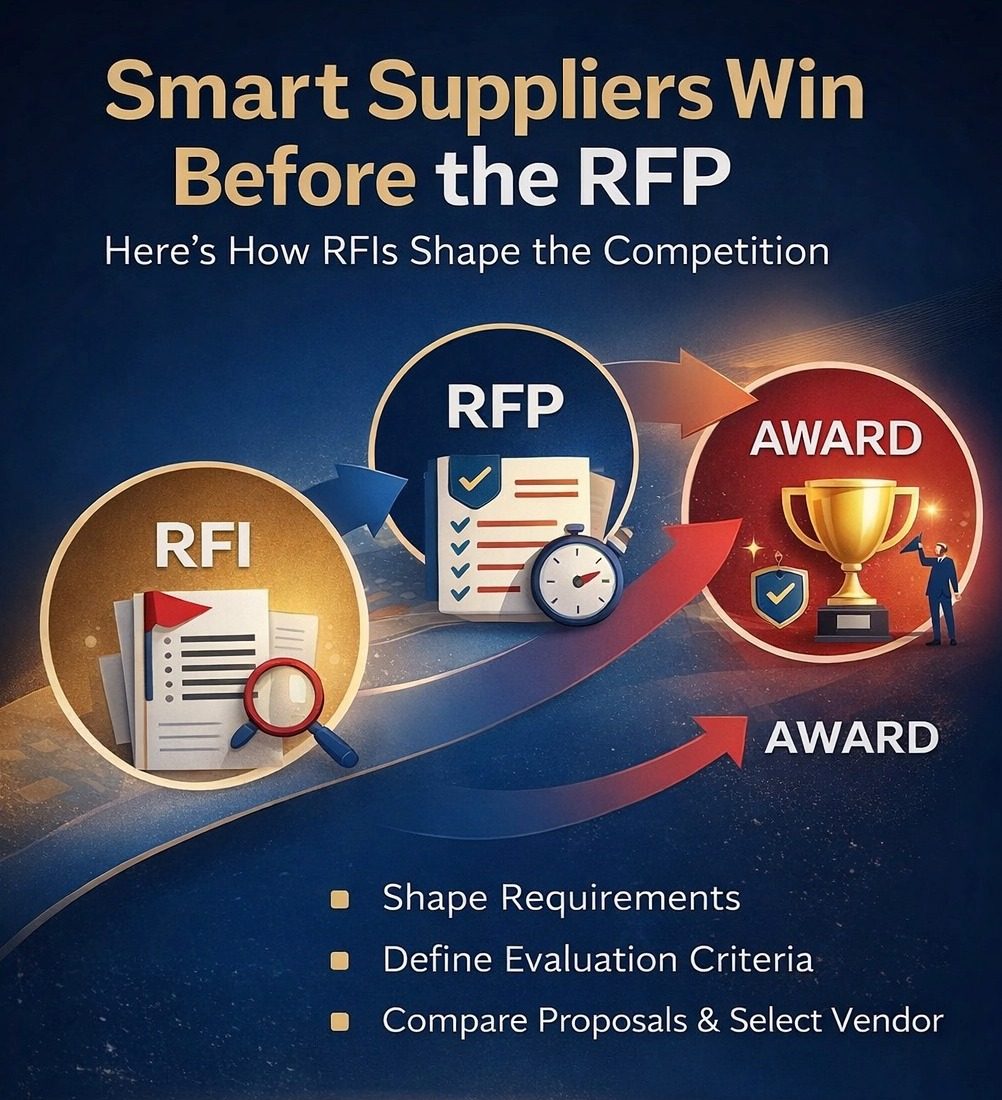
The real shaping happens earlier often quietly during the Request for Information phase.
RFIs are not issued because buyers lack vendors. They are issued because buyers are trying to reduce uncertainty before committing to formal requirements. At this stage, agencies and enterprises are not looking for polished sales narratives. They are looking for perspective, validation, and foresight.
This is where experience matters.
An RFI is effectively the buyer asking: What are we not thinking about yet? What risks will surface later if we get this wrong now? What does a successful outcome actually look like in practice, not just on paper?
Organizations that have lived through multiple procurement cycles understand that RFIs are used to pressure-test assumptions, explore delivery models, and identify constraints that may not be visible in early planning. Security, data governance, workforce readiness, transition risk, stakeholder adoption, and schedule realism are all quietly evaluated at this stage.
By the time the RFP is released, many of these decisions are already embedded in the structure of the solicitation.
RFPs, by design, are comparison tools. They are built to evaluate vendors side-by-side against predefined criteria. Flexibility is limited, creativity is bounded, and deviation from the stated approach is often penalized. The buyer is no longer exploring options they are validating choices.
This is why suppliers who treat RFIs as an administrative step routinely find themselves misaligned later. When RFI responses are rushed, generic, or overly promotional, they fail to influence the very factors that will later determine evaluation scores.
In contrast, well-constructed RFI responses bring clarity. They help buyers articulate outcomes rather than just outputs. They surface trade-offs between speed, cost, risk, and quality. They provide practical insight into what has worked and what has failed in similar environments. Over time, these inputs shape evaluation criteria, performance metrics, and even the feasibility of certain solution approaches.
From a proposal development standpoint, RFIs also create continuity across the lifecycle. Strong RFI responses establish early narrative anchors that carry forward into the RFP. They frame the problem in operational terms, introduce realistic success measures, and align expectations between buyer and supplier long before final proposals are scored.
At GenTechPro, our approach to RFIs is grounded in decades of hands-on experience supporting federal, state, local, and commercial procurements. We have seen how early signals influence final outcomes. We have watched evaluation models evolve based on insights shared during RFIs. We have also seen how missed opportunities at this stage are nearly impossible to recover later.
That experience informs how we advise clients today.
We treat RFIs as strategic instruments not compliance checklists. Our focus is on helping buyers think clearly and helping suppliers respond with substance, discipline, and foresight. The objective is not to sell, but to guide the decision framework that will ultimately define the RFP.
When RFIs are approached with this level of intent, the RFP becomes far more predictable. The proposal is no longer written in the dark. It is built on a foundation the supplier helped shape.
The most successful organizations understand this reality. They do not wait for the RFP to start competing. They engage earlier, think deeper, and influence responsibly.
After thirty years in this domain, one lesson stands out clearly:
Procurements are won by those who help define the problem not just those who respond to it.