
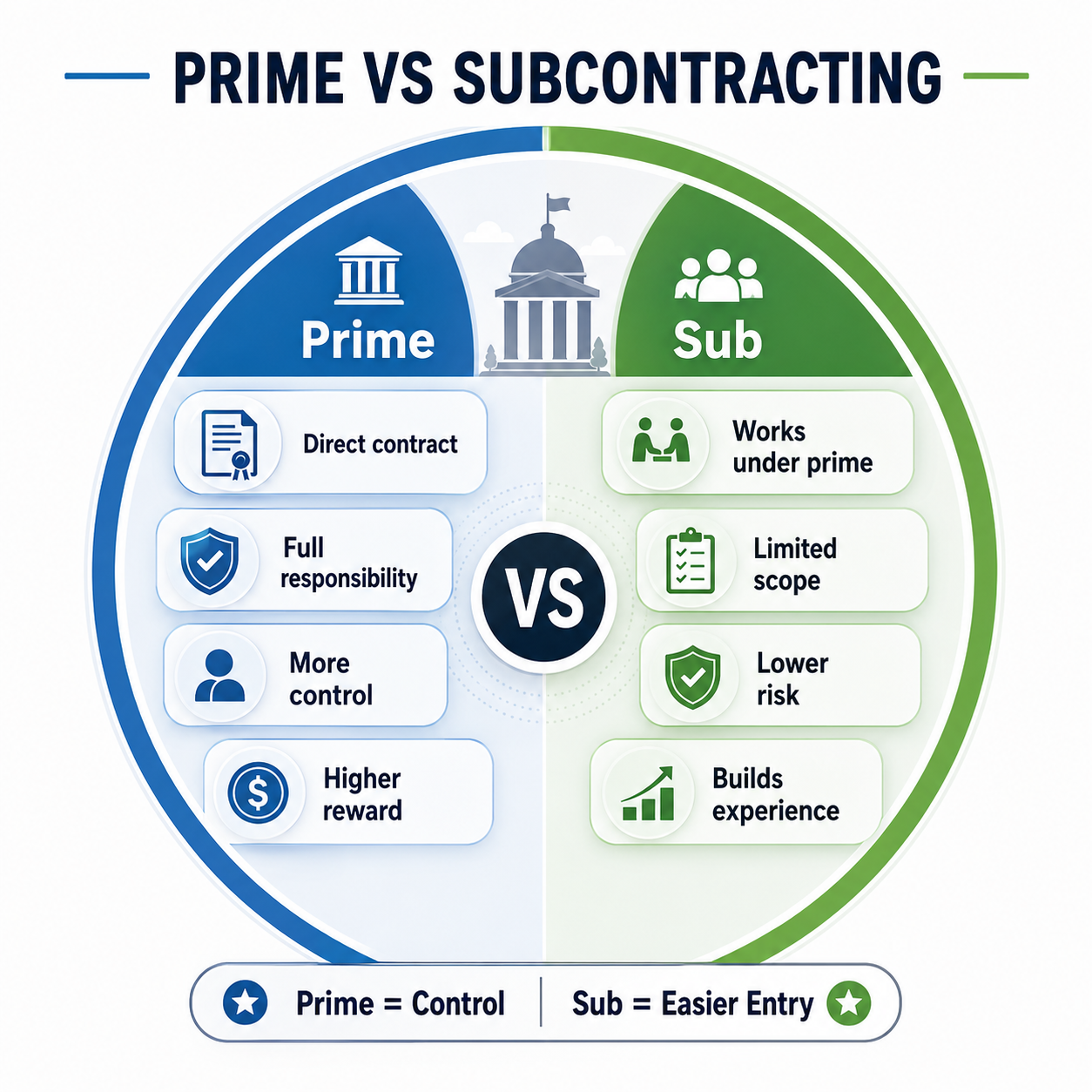
If you’re a small business owner eyeing the government contracting space, one of the first strategic decisions you’ll face is whether to pursue work as a prime contractor or as a subcontractor. Both paths lead to the same destination – government revenue and long-term growth – but the routes look very different. Understanding those differences early can save you from costly missteps and help you choose the entry point that actually fits your current capacity, risk tolerance, and business goals.
What Prime Contracting Really Means
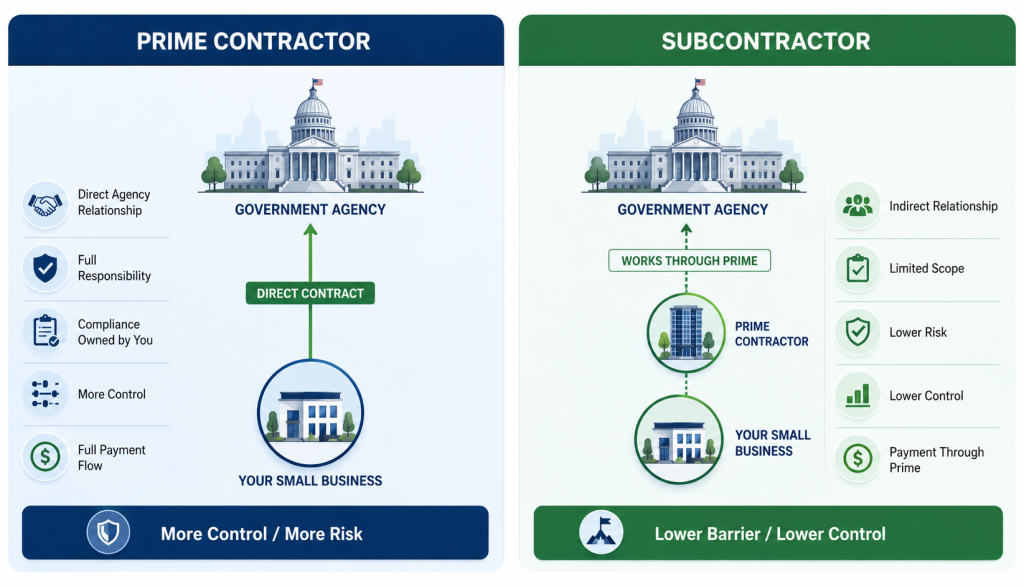
When you’re a prime contractor, you hold the contract directly with the government agency. There’s no intermediary between you and the client. This direct relationship comes with both prestige and pressure.
As the prime, you own every deadline and every deliverable outlined in the contract. If the schedule slips or the scope isn’t met, that responsibility lands squarely on your shoulders – not a partner’s. You’re also on the hook for managing all FAR (Federal Acquisition Regulation) compliance and reporting requirements, which can be a significant administrative lift, especially for a business that hasn’t built out a dedicated compliance function yet.
On the financial side, being a prime has real advantages. Payment comes straight from the government, with no middleman taking a cut or introducing payment delays. Every contract you complete as a prime builds your own past performance record, which becomes one of your most valuable assets when bidding on future work. You also keep the full contract margin for your business, rather than sharing it with a partner.
Primes control how the work gets delivered and staffed, which means more autonomy but also more accountability. If something goes wrong on the job, you’re the one answering for it. And because winning as a prime usually requires proven past performance, this path tends to favor businesses that already have a track record – or are prepared to invest heavily in building one. For companies that succeed here, growth means winning bigger contracts under their own name, steadily expanding their footprint and reputation in the federal marketplace.
What Subcontracting Really Means
Subcontracting flips the structure. Instead of holding the prime contract, you perform work under a prime contractor’s award. This arrangement is often the more accessible entry point for businesses that are newer to government contracting or don’t yet have the infrastructure to manage a prime relationship on their own.
As a subcontractor, you’re responsible only for your defined portion of scope – not the entire project. The prime handles most of the compliance and reporting burden, which frees you up to focus on doing the work you’re actually good at, rather than navigating the full weight of federal regulations. That said, payment comes from the prime, not the government directly, which means your cash flow depends on the prime’s payment practices and timelines rather than a direct government disbursement.
One of the biggest advantages of subcontracting is that you gain real experience, even without your own CPARS (Contractor Performance Assessment Reporting System) rating. This is huge for businesses trying to build credibility in the space. You do receive a smaller share of the total contract value compared to what a prime earns, and you’ll generally follow the prime’s direction on project delivery rather than calling the shots yourself.
Because subbing is often an easier entry point if you’re new, your risk exposure is also lower than the prime’s liability – the prime carries the bulk of the contractual risk. Growth as a subcontractor typically looks different too: instead of winning bigger contracts under your own name, it means teaming with more primes and taking on larger scopes within those partnerships.
Which Path Should You Choose?
There’s no universally “better” option here – the right choice depends on where your business stands today.
If you’re just entering the federal marketplace, subcontracting can be a smart way to build experience, establish relationships with established primes, and start generating a performance history without shouldering the full weight of compliance and risk. It’s a lower-barrier way to prove your capabilities and start building the reputation you’ll eventually need to win prime contracts of your own.
On the other hand, if you already have a proven track record, the operational infrastructure to manage FAR compliance, and the appetite for direct accountability, prime contracting offers greater control, better margins, and the ability to build your business’s name recognition directly with government agencies.
Many small businesses actually do both simultaneously – subcontracting on some projects to maintain steady cash flow and gain experience, while pursuing prime contracts on others to grow their independent past performance record. This blended approach can be an effective way to de-risk your growth strategy while still positioning your business for bigger opportunities down the road.
Building the Foundation for Either Path
Whichever route you choose, success in government contracting depends heavily on having the right operational backbone in place. Compliance tracking, secure data handling, reporting systems, and reliable IT infrastructure aren’t optional extras – they’re often prerequisites for even being considered, whether you’re bidding as a prime or being vetted as a subcontractor by a larger firm. This is where working with a knowledgeable technology partner can make a real difference. GenTechPro IT Solutions specializes in helping small businesses build the compliant, secure, and scalable IT foundations that government contracting demands – from cybersecurity and data protection to the systems needed to support FAR-compliant reporting. Whether you’re preparing to bid as a prime contractor or positioning yourself as a reliable subcontractor, partnering with a team like GenTechPro IT Solutions can help ensure your infrastructure is ready to support your growth, not hold it back.